Your cart is currently empty!
Tag: NAPLAN
-
Reevaluating NAPLAN: How Shifting the Test Dates Could Enhance Learning Outcomes
Aussie Edu Hub
Love it or hate it, NAPLAN has become a key fixture in the Australian school calendar. This year, it’s arriving earlier than ever – set for March 15, a full two months ahead of previous years. But what does this shift actually mean for students, parents, and teachers? According to Dr Selina Samuels, Chief Learning Officer at Aussie Edu Hub, the change could be a step in the right direction.
“Moving the tests earlier gives teachers more time throughout the year to use the results in a meaningful way,” Dr Samuels explains. “They can analyse the data and adjust their teaching to meet students’ individual learning needs. This transforms NAPLAN into a more useful tool for both diagnosis and progress tracking.”
More Than Just a Date Change
NAPLAN 2023 also brings other updates. The NAP Sample assessments – which test Years 6 and 10 students in science, civics and citizenship, and digital literacy – will now occur in Term 2 instead of Term 3. These assessments, which were previously conducted every three years, will transition into optional annual assessments, to be phased in over the next three years.
“These subjects are increasingly important in preparing students for the future,” says Dr Samuels. “By testing them nationally, we’re creating benchmarks to ensure consistent teaching standards across the country. It also helps identify areas that need more focus or support.”
Tackling Student Anxiety
One of the long-standing concerns around NAPLAN is the stress it can cause—especially for younger students. Dr Samuels points out that much of this anxiety stems from lack of preparation.
“When students are underprepared, it naturally leads to anxiety. But by giving them time to build and consolidate their literacy and numeracy skills in advance, they’re more likely to feel confident,” she says.
She adds that NAPLAN isn’t just about assessment; it’s an opportunity for students to demonstrate essential academic skills that form the foundation for future learning.
“Helping students understand the structure of the tests is also key. NAPLAN questions, especially in maths and writing, can be unfamiliar. Giving students practice with the format allows them to demonstrate what they truly know.”
Practical Tips for NAPLAN Prep
To help students feel more prepared and perform at their best, Dr Samuels shares these practical strategies:
- Talk to your child’s teachers about how the school is preparing for NAPLAN. For students in Years 5, 7, and 9, reviewing past performance can help identify areas to improve.
- Pinpoint learning gaps early. Focus on core skills like time management, reading comprehension, and multi-step problem-solving.
- Practice with NAPLAN-style questions. This reduces the element of surprise and builds test-taking confidence.
- Teach test strategies. Encourage students to find ‘quick wins’ on multiple-choice sections and avoid getting stuck on tough questions.
- Adopt a growth mindset. Remind your child that NAPLAN isn’t a pass/fail exam – it’s a chance to show progress and apply skills learned in class or through tutoring.
- Follow up after results. Whether your child needs to catch up, stay on track, or stretch further, understanding the results helps you take the next best step.
“At Aussie Edu Hub, our tutors work closely with students on both skill-building and test strategies,” says Dr Samuels. “Our goal isn’t just success in NAPLAN, but building literacy and numeracy skills that last a lifetime.”
-
NAPLAN 2026 Introduction
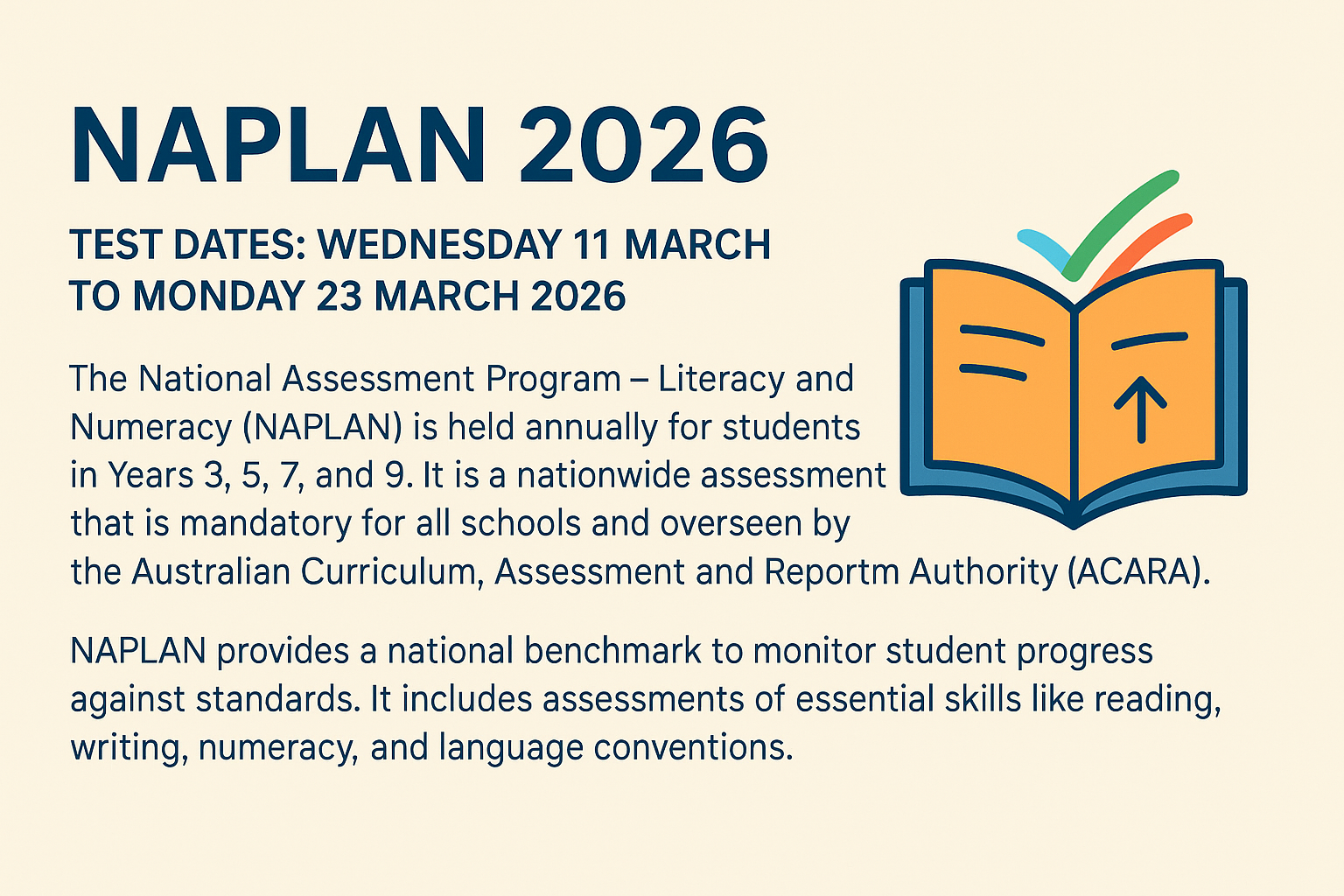
Test Date: Wednesday 11 March to Monday 23 March 2026
The National Assessment Program – Literacy and Numeracy (NAPLAN) is conducted annually for students in Years 3, 5, 7, and 9 across Australia. This nationwide assessment is mandatory for all schools and is overseen by the Australian Curriculum, Assessment and Reporting Authority (ACARA), which manages the planning and development of the program.
NAPLAN provides a national benchmark to monitor student progress in relation to established standards. It offers valuable insights into how students perform compared to their peers nationwide, highlighting areas where further support may be needed.
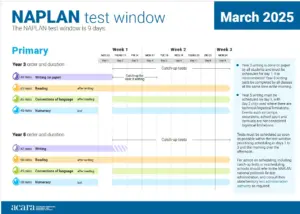
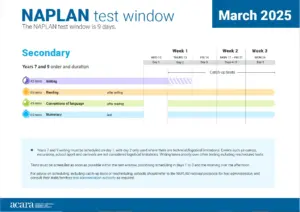
The assessment focuses on key skills essential for daily life, such as interpreting information, filling out forms, and understanding mathematical concepts. It covers numeracy, reading, writing, and language conventions (spelling, grammar, and punctuation).
With Aussie Edu Hub Online Test, your child’s chances of achieving top band scores in the NAPLAN assessment are enhanced.
At Aussie Edu Hub, we provide exam-style practice tests tailored for both primary and secondary school students. These practice tests help students experience the feel of a real exam, building their confidence and familiarizing them with the format and expectations of the NAPLAN assessment.
Our tests foster a deep understanding of the exam structure and reinforce the core skills required for your child’s year level. In addition, we offer a comprehensive, personalized One-to-One approach to strengthen conceptual clarity and develop effective study techniques.
-

Who We Are — Welcome to Aussie Edu Hub
At Aussie Edu Hub, we are passionate about helping Australian students achieve their personal best in the NAPLAN tests and beyond.
We are an Australian-based platform created by educators, parents, and technologists who understand both the challenges and opportunities NAPLAN presents for students today. Our mission is simple:
👉 Empower students to feel confident and prepared for NAPLAN
👉 Support parents with trusted tools and insights
👉 Deliver practice content that mirrors the real test experience
Why Choose Aussie Edu Hub?
Unlike generic worksheets or outdated practice books, Aussie Edu Hub provides an interactive and adaptive online learning platform specifically designed to simulate the actual NAPLAN online experience.
Here’s why parents and students trust us:
✅ Realistic Test Experience
Our questions follow the exact formats and styles students will face on the NAPLAN test. Practicing with Aussie Edu Hub builds familiarity, reduces test anxiety, and helps students approach the real test with confidence.✅ Interactive Practice
Our platform is fully interactive—students can practice the drag and drop, click to select, dropdowns, typing, writing—exactly like the real online test.✅ Build Mastery Over Time
We provide detailed feedback and explanations so students not only practice but also understand their mistakes and learn from them.✅ Parent-Friendly Insights
Parents get clear reports on their child’s progress and areas for improvement. You’ll know exactly how your child is tracking and where to focus support.✅ Designed for Australian Classrooms
Our questions are aligned with Australian Curriculum and NAPLAN test frameworks, making our practice highly relevant.
Our Question Features — What Your Child Will Practice
Here are the exact question styles your child will face when using Aussie Edu Hub — these match what they’ll see on the actual NAPLAN online test:
📝 Literacy & Numeracy Question Types:
-
Multiple Choice
Traditional format where students select one correct answer from several options. -
Sentence Selection
Students click on specific words within a sentence to select their answers. The sentence contains multiple highlighted words that can be selected. -
Selection Multiple
Students select multiple correct answers from a set of options. -
Multiple True/False
Students evaluate multiple statements as either true or false. -
Word Matching
Students match words or phrases with their corresponding pairs. -
Drag and Drop Images
Students drag images to their correct positions or categories. -
Dropdown Selection
Students select the correct option from dropdown menus within text. -
Multiple Choice Image
Students select the correct image from multiple options. -
Drag to Order
Students arrange items in the correct sequence or order. -
Drag to Choice
Students drag items to their corresponding choice or category. -
Drag to Group
Students drag items to form logical groups or sets. -
Grid to Choice
Students select cells in a grid to indicate their answers. -
Fill the Blank
Students type in missing words or phrases to complete sentences. -
Writing
Students compose extended written responses to prompts — just like the NAPLAN writing test.
Our Promise to Parents & Students
With Aussie Edu Hub, your child is not just practicing random questions — they are practicing the right questions in the right format with the right level of support.
By using Aussie Edu Hub regularly, your child will:
✅ Build familiarity with the NAPLAN test interface
✅ Master the full range of NAPLAN question styles
✅ Develop stronger literacy and numeracy skills
✅ Approach test day with confidence and reduced anxietyAnd as a parent, you will:
✅ Gain visibility into your child’s progress
✅ Know where your child needs help
✅ Have peace of mind that your child is well-prepared
Join Aussie Edu Hub Today
NAPLAN is an important milestone—but with the right preparation, it can be a positive and empowering experience.
Join thousands of Australian families already using Aussie Edu Hub to give their children the tools, skills, and confidence they need to shine.
👉 Start today and help your child succeed with Aussie Edu Hub!
-
-

How to Use Aussie Edu Hub
A simple step-by-step guide for parents and students
1️⃣ Parent Registration
First, parents need to register an account on our platform. It only takes a minute!

2️⃣ Purchase Test Packs
After registering, parents can browse and purchase test packs directly from our platform.

3️⃣ Access Parent Dashboard
Once you have purchased a test pack, you can manage everything from your Parent Dashboard.
4️⃣ Create a Student Account
In the Parent Dashboard, you will create a Student Account for your child.

5️⃣ Assign Test Packs to Your Child
After creating your child’s account, assign the purchased test pack to your child so they can begin practicing.

6️⃣ Student Login
Your child can log in to their Student Dashboard in two ways:
-
Via web browser (on any computer or tablet), or

-
By downloading the AEH Student Portal app on their iPad for an optimized experience.
7️⃣ Select & Start a Test
From the Student Dashboard, your child can choose the category of test they want to take and then select a specific test to start.


8️⃣ Submit the Test
After completing the test, your child should submit the test through the platform.

9️⃣ Review Test Attempts & Scores
To review progress, your child can go back to the Student Dashboard, click on the same test, and select “View Attempts” to see their detailed results and scores.


-
-

NAPLAN Aligned with the Australian Curriculum
NAPLAN Aligned with the Australian Curriculum
Since 2016, NAPLAN tests have aligned with the Australian Curriculum: English and Mathematics. The NAPLAN Assessment Framework outlines what is assessed and how the tests are designed.
States and territories are gradually implementing Version 9.0 of the Australian Curriculum. In the meantime, NAPLAN tests skills aligned with both Versions 8.4 and 9.0.
The best preparation for NAPLAN is regular teaching of the curriculum. Test questions primarily assess literacy and numeracy skills taught in previous school years, with some content drawn from the current and following year, designed to be accessible based on prior learning.
For detailed descriptions of skills assessed, see Proficiency Level Descriptions.
Writing
NAPLAN writing tests assess students’ ability to write accurately, fluently, and purposefully in Standard Australian English. Students respond to a writing prompt in either a narrative or persuasive text type.
-
All students write the same text type; Year 3 students complete the test on paper, while Years 5, 7, and 9 complete it online.
-
Prompts vary by year level and test day but are of similar difficulty.
-
Students’ writing is marked using a national 10-criteria rubric to ensure consistent assessment across Australia.
Writing marking guides and sample prompts are available for both persuasive and narrative writing.
Reading
The reading tests measure students’ literacy proficiency in alignment with the Australian Curriculum: English.
-
Students read a variety of texts and answer related questions.
-
Question formats include multiple-choice, drag-and-drop, hot-text, and other technology-enhanced types.
-
Texts vary in complexity based on each student’s pathway through the tailored test design.
Conventions of Language
These tests assess spelling, grammar, and punctuation in alignment with the Australian Curriculum: English.
-
The tests focus on the conventions of written Standard Australian English, essential for reading and writing.
-
The test includes two sections: spelling, followed by grammar and punctuation.
-
Question formats include multiple-choice, text entry, and technology-enhanced items.
Numeracy
The numeracy tests assess students’ application of mathematics knowledge and skills based on the Australian Curriculum: Mathematics.
-
The tests cover number and algebra, measurement and geometry, and statistics and probability.
-
Question formats include multiple-choice, text entry, and technology-enhanced items.
For Years 7 and 9, the numeracy test includes two sections:
-
A non-calculator section to assess mental arithmetic.
-
A calculator section for the remainder of the test.
Summary
NAPLAN provides a nationally consistent assessment aligned with the Australian Curriculum, helping track students’ literacy and numeracy progress. The tests are designed to reflect the curriculum while supporting consistent evaluation across all Australian states and territories.
-
-

How Writing is Marked in NAPLAN
The NAPLAN writing test plays a key role in assessing students’ ability to write clearly, accurately, and purposefully in Standard Australian English. Each year, students in Years 3, 5, 7, and 9 are asked to produce a piece of writing in response to a given prompt. But how is this writing assessed? Here’s a closer look at the marking process behind the NAPLAN writing test.
The Writing Task
Students are provided with a writing prompt, which may be either:
-
a narrative (telling a story), or
-
a persuasive text (arguing a point of view).
The prompt is the same for all students in the same year level, though Year 3 students complete their test on paper, while Years 5, 7, and 9 complete the test online.
The text type (narrative or persuasive) is not revealed until test day, so preparation should focus on building a strong foundation in writing skills across both text types.
How the Writing is Assessed
Each student’s writing is marked against a nationally consistent rubric known as the NAPLAN Writing Marking Guide.
The writing is evaluated across 10 criteria, which focus on both the structure and mechanics of writing, as well as creativity and purpose.
The 10 marking criteria are:
-
Audience – how well the writing engages the reader.
-
Text structure – overall organisation and flow of the text.
-
Ideas – relevance, quality, and development of ideas.
-
Character and setting (for narrative) or persuasive devices (for persuasive) – effectiveness of specific writing techniques.
-
Vocabulary – word choice and appropriateness.
-
Cohesion – how well the text connects ideas and flows logically.
-
Paragraphing – use of paragraphs to organise writing.
-
Sentence structure – variety and correctness of sentence patterns.
-
Punctuation – correct and effective use of punctuation marks.
-
Spelling – accuracy of spelling across the text.
Each criterion is scored on a scale of 0 to 6, depending on year level and text type.
The Marking Process
1️⃣ Trained Markers
-
Writing tests are marked by trained assessors who have undergone intensive training in using the national marking guide.
-
Markers across all Australian states and territories receive the same training and use the same rubric, ensuring consistency in marking.
2️⃣ Double Marking
-
To maintain quality and fairness, many writing samples are double-marked by two different assessors.
-
If scores vary significantly, a third marker is used to resolve discrepancies.
3️⃣ Quality Assurance
-
The marking process is supported by ongoing quality assurance checks.
-
Senior markers and team leaders supervise marking and conduct regular checks to ensure consistent application of the marking guide.
Why This Matters
The writing test gives students an opportunity to demonstrate essential writing skills that are vital for school and life beyond the classroom.
For teachers, parents, and education authorities, the results:
-
Provide insights into students’ writing strengths and areas for improvement.
-
Support targeted teaching and learning strategies.
-
Help track writing progress over time.
Key Points to Remember
-
No text type choice: Students must write to the text type revealed on test day.
-
Multiple prompts may be used within each year level, but all are of similar difficulty.
-
Preparation should focus on building writing skills, not memorising responses.
-
Markers follow a consistent national rubric to ensure fairness and accuracy.
Conclusion
The NAPLAN writing test provides a robust measure of students’ ability to communicate effectively in writing. Through a structured and consistent marking process, every effort is made to ensure that results are fair, reliable, and meaningful for students, teachers, and parents alike.
-